Sustainability

Sidestream Valorisation

Packaging

Transport

Product Quality and Safety
 Soybeans

A second chance for our tofu in Slovakia

Soybeans
ESG Reports
2024 - ESG Report
Selected Sustainability Initiatives
A common path with many stages.
As our group continues to grow, we recognise that sustainability across our locations is still evolving. We are on a purposeful journey – understanding where we stand, measuring our impact, and shaping effective group-wide solutions to reduce it.
While building towards a shared approach, we proudly recognise the meaningful contributions of each subsidiary – each step advancing a more responsible and connected food culture.

We believe in second chances – and so does our tofu in Slovakia
Sidestream Valorisation


Packaging Innovation – Slovakia
Plastic foils
Plastic foils we use are recycable, which is verified by certificates from our suppliers.
Cardboard sleeves
Cardboard sleeves we use are sourced from forests managed by the Forest Stewardship (FSC), an organiztation dedicated to preserving forests through responsible management, which includes conserving biodiversity, water resources, and soil quality. For more information about our sustainability in Slovakia visit Lunter Brand website.
Transport in Slovakia – Smarter Logistics


Product Quality and Safety
Our products must meet the highest standards – in taste, integrity, and safety.
Across our group, we uphold strict hygiene and working conditions, supported by internationally recognised food quality certifications such as
- IFS Food Certification,
- BRCGS Global Standard Food Safety, and
- ISO 22000 Food Safety Management System Certification.
This sets criteria for our products that they are crafted under reliable systems that protect both people and product quality – every step of the way.
Tofu: Simple ingredients. Measurable impact.
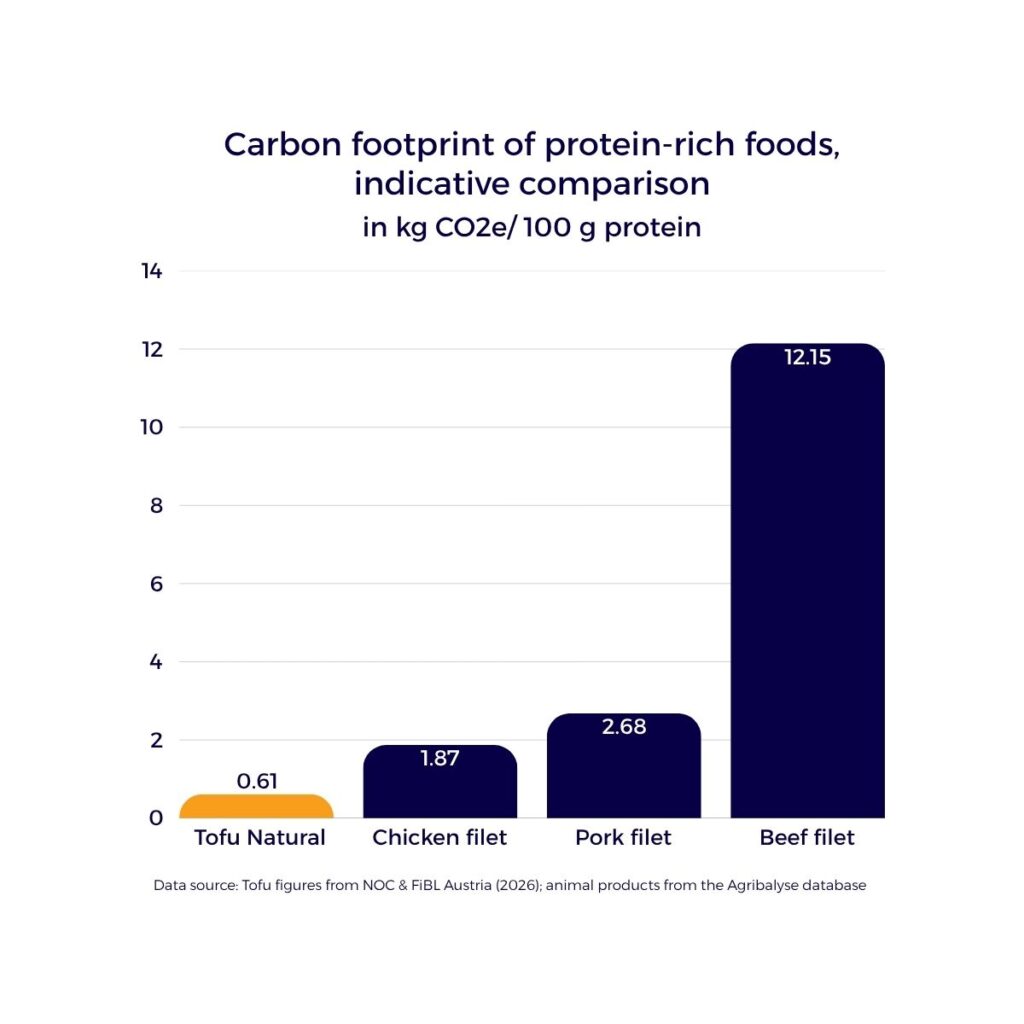
1. Primary data for Europe Soya certified and average European soybeans: https://www.donausoja.org/scope3-corporate-carbon-footprint/
2. Average of four publications: Ritchie, H., et al (2022) - Environmental Impacts of Food Production” Published online at OurWorldinData.org; Mejia, A., et al. (2018). Greenhouse Gas Emissions Generated by Tofu Production: A Case Study. Journal of Hunger & Environmental Nutrition, 13(1), 131–142. https://doi.org/10.1080/19320248.2017.1315323; Head, M., et al. (2011). Life Cycle Impacts of Protein-rich Foods for Superwijzer. Available under: https://cedelft.eu/wp-content/uploads/sites/2/2021/04/2329_finalreportMHSD_1339077247.pdf; Blonk, H., et al. (2008). Milieueffecten van Nederlandse consumptie van eiwitrijke producten. Available under: https://edepot.wur.nl/117665
3. Figures for animal based food products were obtained from the Agribalyse database. https://agribalyse.ademe.fr/
Looking ahead
We’re committed to continuously improving our sustainability performance – and to sharing that journey with transparency.
Across our group, many initiatives are already underway, and more are in development.
We look forward to sharing future progress with you.
For questions or collaboration:
Leopold Rittler